
The Occupational Safety and Health Administration was authorized by Congress in 1970 to develop and enforce standards that guarantee safe and healthy conditions for workers as well as to provide education and training. OSHA regulates the use of compressed air blow guns in the workplace, with rules for operating air guns from the air supply source to the tip of the work tool.
Pressure-Relief Devices
OSHA requires a safety device for any supply or branch lines with an inside diameter of more than 1/2-inch. The safety device reduces pressure to the pneumatically driven tool in case the hose fails.
Nailers
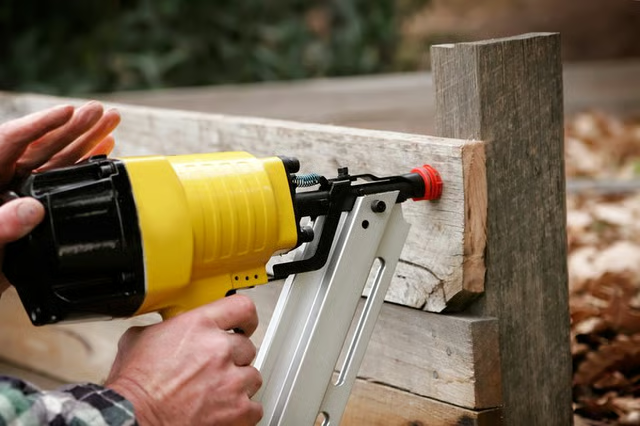
Air-driven nailers, staplers or other such devices with an automatic feed for the fasteners have a 100-psi threshold before contact muzzles are required. A muzzle prohibits fasteners from being discharged unless the muzzle is in contact with the work surface.
Secure Coupling
To prevent an accidental uncoupling of an air gun from its air supply, OSHA mandates securing the tool to the hose "by some positive means." In explaining this requirement, a 2003 OSHA interpretation letter said quick disconnect and pull-down sleeve couplers met the requirements of the standard. A pull-down device requires pulling on a coupling ring and releasing a spring in the coupler. Once the tool is released from the hose, the end of the hose closes. Pulling the sleeve is the positive means necessary to meet the regulation's requirements.
Cleaning With Air
Using compressed air to clean something is generally not allowed, unless pressure at the nozzle is reduced to less than 30 psi -- and then only when wearing effective chip guarding and personal protective equipment, according to OSHA. As explained in a 1994 OSHA interpretation letter, the rule is intended to protect workers exposed to flying chips and debris. Using compressed air for cleaning does not extend to workers cleaning their clothing or skin, however. Another 1994 OSHA interpretation letter clearly states that compressed air could damage the eyes, respiratory system and other parts of the body. OSHA maritime regulations specifically prohibit workers from using compressed air to clean themselves.