


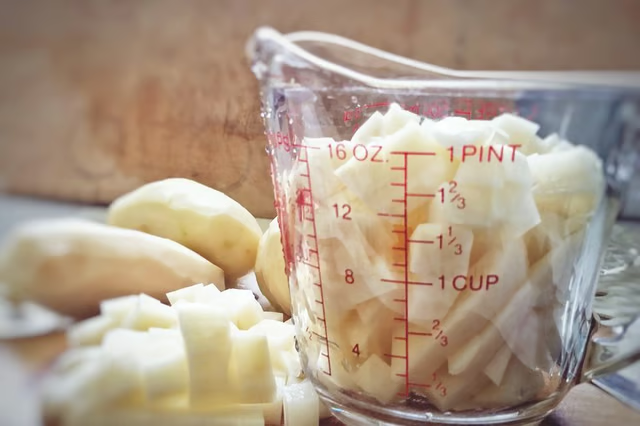
Life would be much simpler if everyone used the same measurement standards, but different units have persisted in different parts of the world. American recipes typically work with cups, which are a measure of volume, while European recipes provide ingredient quantities in grams, which is a unit of weight and is noticeably more precise. The difference is especially important in baking, which requires more precision than cooking.
To convert cup measurements to grams, you'll need a baking scale, which is available inexpensively at most kitchenware stores.
How to Convert Cups to Grams
Converting cups to grams is a bit like measuring apples against oranges. Because a cup is a measure of volume, and a gram is a measure of weight, different substances will convert differently, and your conversion of some ingredients, such as chopped fruits or vegetables, may never be entirely accurate.
- Sugar: To convert 1 cup to grams of sugar, weigh out 201 grams, which is the equivalent of 7.1 ounces. This measurement applies to white sugar, which is less dense than brown sugar. For packed brown sugar, weigh 220 grams to equal 1 cup. This is the equivalent of 7.75 ounces.
-
Rice: As with sugar, the conversion of cups to grams for rice depends on the type of rice you're using.
The cup to grams rice conversion is 1 cup of short-grain brown rice weighing in at 100 grams, or 7.05 ounces, and 1 cup of white, long-grain rice weighing 185 grams, or 6.88 ounces.
* Flour: 1 cup of rice flour weighs 158 grams, or 5.57 ounces, and 1 cup of bread flour weighs 136 grams, or 4.8 ounces. The conversion of 300 grams of flour to cups is 1.86 cups, or 1 3/4 cups plus 2 tablespoons for plain flour, and 1.94 cups, or 1 3/4 cups plus 3 tablespoons for whole-grain flour.
Consider the Variables
A cup of one substance converts to a different number of grams than a cup of another substance because volume (cups) and weight (grams) are different types of measurements. Tightly packed brown sugar is more dense than granulated white sugar; that is, the particles are heavier, and there's less space between them because they're compacted under pressure. A substance that is more dense weighs more than a substance that is less dense even if the two substances take up the same volume.
The difference between cup measurements and gram measurements is especially significant with chunkier foods such as chopped vegetables. If you dice a carrot into quarter-inch pieces, you can fit a lot more in a cup by weight than if you dice the same carrot into 1-inch pieces and then try to fit these pieces into a cup.
The bigger the pieces, the more space there is between them, and more of the cup is taken up by air rather than carrot. When you measure by weight in grams, the spaces between the carrot chunks don't enter into the equation because only the actual substance is weighed.
Cooking vs. Baking
If you add a cup of diced carrot to a stew, it won't matter much whether you add 150 grams of big chunks or 180 grams of smaller pieces. The size of the pieces may affect cooking time, or you may find small pieces more appealing than large ones, but the difference in the quantity itself is unlikely to affect the quality of your recipes, especially if you can make adjustments such as adding some cooking time if you're using larger pieces.
In contrast, if you're baking a cake, and you measure your flour in cups rather than weighing it in grams, you're more likely to upset the delicate chemistry of a recipe, especially if your flour is dense because it has settled or light because it has been sifted.